Guide · August 17, 2026 · 8 min read
AI Employee vs. AI Agent: What's the Difference?
Compare AI employees and AI agents, learn where each fits, and see what businesses need before autonomous software can own real work.
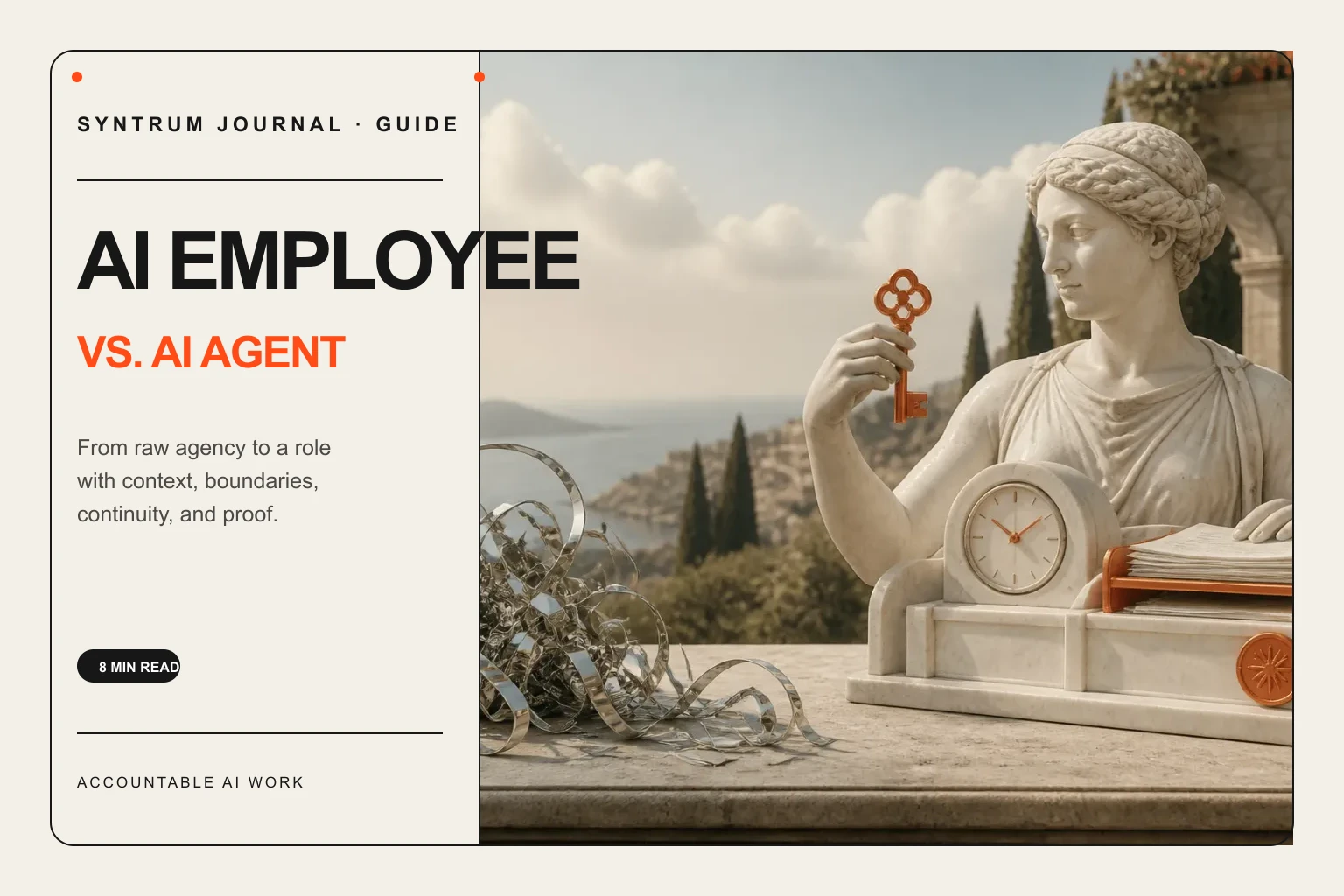
AI agent and AI employee are often used as if they mean the same thing. They do not. An AI agent is a software capability that can reason, choose tools, and take steps toward a goal. An AI employee is an operating model: an agent with a defined role, approved access, supervision, memory, a work schedule, and accountability for outcomes. The distinction matters because a clever demo is not the same as dependable work.
01What is an AI agent?
An AI agent is software that can interpret a goal and decide what to do next. Unlike a basic chatbot, it may call tools, retrieve information, update a system, or continue through several steps without a person scripting every click. Agents are useful building blocks for research, data extraction, routing, drafting, and other bounded tasks.
The defining feature is agency: the system can select actions within the options available to it. That does not automatically give it a job, a manager, or responsibility for a recurring business outcome. Many agents are invoked for one session and disappear when the session ends.
02What is an AI employee?
An AI employee is a persistent digital worker assigned to a specific role. It watches the tools connected to that role, understands incoming work using company context, decides within written rules, acts at the permitted level, and reports what happened. It returns on schedule or responds to events instead of waiting for a fresh prompt every time.
- A role and objective that define what good work looks like.
- Scoped access to the inboxes, records, documents, and actions required for that role.
- Supervision rules that separate read-only work, approval-required work, and autonomous work.
- Durable memory for company facts, corrections, and past decisions.
- A visible task and audit history that connects each outcome to its evidence.
An agent can complete a task. An AI employee is designed to own a lane of work.
03AI employee vs. AI agent at a glance
The categories overlap. Every AI employee uses agentic capabilities, but not every AI agent is operated as an employee. A research agent that gathers sources on demand may be exactly what a team needs. A support role that monitors a queue, drafts replies, escalates exceptions, and records outcomes needs the additional operating structure of an AI employee.
04When should a business use each?
Use a standalone AI agent when the work is occasional, narrow, and easy to verify immediately. Examples include summarizing a document, extracting fields from a contract, or researching a list of companies. The person starting the task remains the owner and reviews the result in the same workflow.
Use an AI employee when the work recurs, arrives through connected systems, and benefits from continuous ownership. Ticket triage, lead follow-up, invoice checks, meeting preparation, and knowledge maintenance are strong candidates because they have recognizable inputs, rules, and definitions of done.
05What to evaluate before you choose
- Can you describe the role in one sentence and name the outcome it owns?
- Can permissions be limited to only the data and actions the role needs?
- Can a person review early work before autonomy expands?
- Does the system verify completion in the tool where the action occurred?
- Will your team be able to reconstruct the reason, approval, action, and result later?
06The bottom line
The difference between an AI agent and an AI employee is not intelligence. It is operational design. Agents provide the ability to reason and act. AI employees add the role, context, access, supervision, continuity, and evidence required to turn that ability into dependable business work.
Syntrum Team
Guides, Syntrum